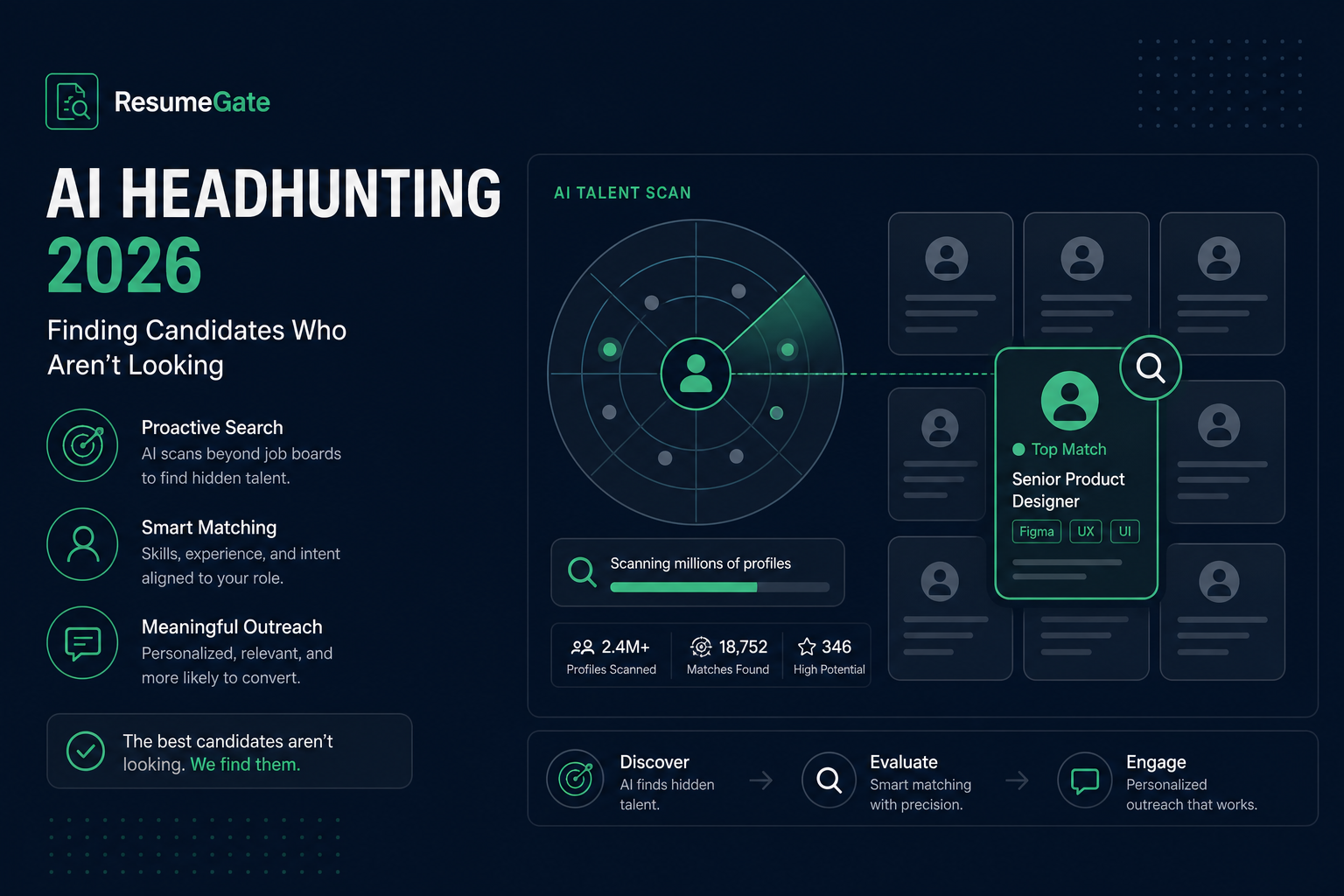
AI headhunting in 2026 means recruiters build ranked shortlists from public professional data—profiles, portfolios, filings, and cached pages—score you against benchmarks cloned from top internal performers, then re-rank by inferred openness to a move before anyone sends a message. You do not need to apply or post "open to work" to land on that list; you need a specific, consistent, parser-readable presence the system can match to a req.
The Tuesday-morning InMail that names your actual stack and employer is usually the last step, not the first. Enterprise teams adopted sourcing automation because manual boolean search could not keep pace with specialized hiring. Understanding list-building—and the signals that bump you up or down—lets you attract better inbound interest and avoid wasting time on low-quality templates. When a sourced conversation turns serious, the same resume still enters Workday or Greenhouse; formatting mistakes can undo a warm intro.
| Sourcing layer | What it does | What you control |
|---|---|---|
| Data aggregation | Pulls public profiles, repos, bios, filings | Accuracy and specificity of listed work |
| Fit scoring | Compares you to ideal benchmark or job profile | Title, skills, tools, scope in plain text |
| Propensity scoring | Estimates likelihood you will respond now | Profile edits, tenure window, content engagement |
| Outreach queue | Ranks top tier for recruiter or automated send | Reply triage; keep ATS-ready resume on hand |
Key Takeaway
- Sourcing ranks fit first, readiness second—both are readable from public data
- Specific titles beat broad appeal for match scores
- Inbound interest still hits ATS—keep a parser-safe resume ready
- Triage messages with three short questions before booking calls
How AI sourcing tools build a candidate list
Modern sourcing is not one keyword search on a single platform. Aggregators combine professional network profiles, code repositories, conference speaker lists, personal sites, and—for licensed roles—public regulatory records. The composite profile is richer than any one bio field, which is why inconsistent dates between your resume and public profile create matching noise.
Fit scoring replaced pure Boolean strings at many enterprises. A hiring manager uploads three internal top performers; the system extracts shared patterns—title progression, skill clusters, employer types, education signals—and searches outward for external profiles with similar vectors. Keyword overlap still matters, but resemblance to a proven employee is the stronger filter for senior reqs.
The EEOC guidance on employment selection procedures reminds employers that automated ranking must still comply with anti-discrimination obligations. Candidates will not see compliance work behind the scenes, but it explains why some firms keep humans in the loop before outreach sends—even when the shortlist is machine-ranked.
Propensity scoring sits on top: among qualified profiles, who looks receptive this quarter? Recent profile edits, skills additions, career-content engagement, and tenure crossing typical move windows all add weight. None of these are formal declarations—you might update a headline after a certification, not because you plan to quit. The system treats the signal the same.
Key Takeaway: you can be highly qualified and still rank lower if your profile is sparse or stale compared with a peer the system reads more clearly.
Signals that make you look “likely to move”
Propensity models infer timing from behavior, not from what you tell friends. Common inputs in 2026 deployments include:
| Signal | How systems usually read it | If you want less inbound |
|---|---|---|
| Profile refresh | Possible active search or repositioning | Batch edits; avoid drip updates |
| New skills added | Targeting higher-level reqs | Add only when permanent, not exploratory |
| Tenure milestone | Statistical move window for role level | Cannot hide tenure—control other signals |
| Career content engagement | Market curiosity | Reduce likes or follows on job-search topics |
| Open-to-work toggle | Strong active signal on supporting platforms | Leave off unless you want volume |
If you want fewer pings, keep public profiles static during settled periods. If you want better pings, edit deliberately toward the role type you want—not a vague superset of every possible job.
Common Mistake: turning on "open to work" and expecting only senior, targeted outreach—volume rises, quality often drops.
Profile and resume fixes that improve match quality
Sourcing reads public surfaces; ATS reads your application file. Both need aligned facts. Workday autofill frequently scrambles LinkedIn PDF exports with two-column layouts. Greenhouse keeps single-column text but still misses skills buried in graphics. Lever and iCIMS recruiters often compare your upload against the profile that triggered outreach—discrepancies slow trust.
| Before (low match) | After (higher match) |
|---|---|
| Headline: Director | Leader | Strategist. Skills: leadership, strategy, teamwork. Resume: Canva two-column PDF. | Headline: Director of Product, B2B SaaS ($40M ARR) | PLG, Salesforce ecosystem. Skills: roadmap, pricing, Salesforce CPQ, Workday HCM integrations. Resume: single-column DOCX with matching titles and dates. |
| Experience: "Managed team and delivered projects on time." | Experience: "Led 9-person PMO implementing Workday Recruiting + Greenhouse bridge for 3,200-employee rollout; cut time-to-fill 22% in two quarters." |
| Open-to-work banner on, profile unchanged 3 years, resume not updated since 2022. | Targeted headline refresh, three scoped bullets with metrics, parser-safe resume synced to profile—open-to-work only when actively interviewing. |
Clarity of role type beats breadth. A profile trying to mean product, program, and sales leadership at once scores lower against any single req than a focused product operations story. For LinkedIn-specific discovery mechanics, see what gets you found on LinkedIn in 2026 . For why inbound candidates sometimes interview differently, read why passive candidates get more interviews .
Mid-article check: run your resume against a target req on HireFlow's Job Match Score to see whether keyword and scope gaps explain off-target outreach.
Quick Check: do title, employer, and date ranges match exactly across profile and resume? If not, fix that before your next reply.
How to triage AI-flavored recruiter messages
Better sourcing tools personalize with real project references; mass campaigns insert your name and company into a template. Three questions separate them in under two minutes:
- What level and team size? Real reqs answer in one sentence. Vague replies push calendar links without context.
- What in my background triggered outreach? Forces specificity. Templates collapse into generic praise.
- What is the compensation band? Reasonable before a screen. Mis-leveled sourcing wastes both sides' time.
High-quality signs: named project or publication, concrete team context, level calibrated to your tenure. Low-quality signs: urgency without detail, sender only visible inside the message, role description that fits forty profiles.
The FTC's guidance on deceptive marketing practices is not a recruiting law, but the same skepticism applies: polished automation can mimic human research. Verify the company, req, and recruiter identity before sharing confidential documents.
Pro Tip: say yes to a call only after you have a parser-safe resume ready—sourced candidates still upload into Workday or Greenhouse.
What happens after you say yes: ATS still gates the process
Warm intros skip the black hole myth, not the database. Recruiters create a candidate record, attach your resume, and route approvals in the same ATS stack as cold applicants. Hiring managers may compare your file to the sourced profile that caught attention—if the resume version is weaker or mis-parsed, momentum stalls.
Referral metadata sometimes travels with sourced candidates—"found via LinkedIn sourcing" versus "employee referral" can affect how quickly your packet moves, but it does not bypass document quality. Treat every sourced path as requiring the same parser-safe resume you would use for a cold application on the company careers site.
Common failure points: LinkedIn PDF with scrambled dates in Workday, skills icons that Greenhouse cannot index, header contact blocks dropped on import into Lever. Keep a single-column master file and a public profile that tell the same story. Understanding what recruiter AI copilots show hiring managers helps you anticipate what happens after the first screen.
Key Takeaway: sourcing gets the meeting; ATS-safe documentation gets the offer path clean.
Keep a master resume version updated quarterly even when you are not searching. Sourced opportunities move quickly—having to rebuild a parser-safe file during a 48-hour recruiter window is how strong candidates lose momentum.
The tools behind AI headhunting—and what they read
Recruiters rarely run one product in isolation. Enterprise teams stack a sourcing aggregator, an ATS, and sometimes a CRM for nurture campaigns. Common patterns in 2026:
- Sourcing aggregators pull multi-platform data, deduplicate profiles, and score fit before a human opens a tab.
- ATS records in Workday, Greenhouse, Lever, or iCIMS store applications, interview feedback, and—when integrated—sourced profile links.
- CRM sequences automate follow-up emails and InMail batches to ranked lists, which is why message volume rose even when reqs stayed flat.
None of these tools magically "know" you want a job. They infer from structured fields and behavioral proxies. A GitHub profile with recent commits helps engineering sourcing; a published industry article helps policy and research roles; a state license number helps healthcare and legal searches. Match proof to the field you want to be found for.
Internal mobility complicates the picture: some companies run AI sourcing against their own employee profiles for transfer programs before they search externally. A clear internal headline can surface relocation or promotion conversations you did not initiate.
Pro Tip: if outreach references a repo, article, or certification you listed publicly, that detail tells you which signal triggered the message—use it to refine what you emphasize next.
How sourcing differs by industry and seniority
Tech product and engineering sourcing still leads on volume, but finance and healthcare administration caught up fast because specialized compliance language is easier to filter than to train generalist recruiters on. Executive searches combine AI-ranked longlists with human partner review—automation narrows thousands to dozens; humans close the last mile.
| Industry | Common sourced levels | Profile signals that rank well |
|---|---|---|
| Enterprise SaaS | Director+ product, engineering, CS | ARR scope, stack keywords, prior employer tier |
| Financial services | Risk, compliance, operations leadership | Licenses, regulatory programs, audit outcomes |
| Healthcare systems | Admin, informatics, clinical ops | EHR platforms, quality metrics, credential numbers |
| Professional services | Practice leads, specialists | Client industry focus, billable scope, bar/admission |
Entry-level and high-volume hourly roles are rarely worth a sourcing campaign—job boards and referrals still dominate. If you are early career, invest in application quality and referrals more than passive visibility optimization.
Common Mistake: copying a tech-worker profile template when you are in a licensed profession—omit license numbers and regulators never find you.
A four-week plan to improve inbound quality (not just volume)
- Week 1 — Audit alignment. Google your name plus title. Fix stale pages. Export resume to plain text; compare every title and date to your public profile.
- Week 2 — Sharpen positioning. Rewrite headline as target role + domain + scope. Replace soft skills with tools, methods, and metrics in the top three experience bullets.
- Week 3 — Add one proof artifact. Short post, talk summary, or portfolio case study that matches the role type you want sourced for.
- Week 4 — Test and tune. Run Job Match Score against three target reqs. Adjust keywords. Reply to inbound with triage questions; note which messages matched your new positioning.
Batch profile updates in one session if you want a visibility bump; drip edits across a month if you are employed and do not want a propensity spike mid-project.
Quick Check: after week two, ask a colleague what role they think you are targeting from your headline alone—if they guess wrong, sourcing will too.
Separating real sourced outreach from low-quality automation
High-volume sequences mean more noise in your inbox. Real reqs usually include a company you can verify, a role title that maps to a public or internal posting, and answers to specific follow-up questions. Red flags include requests for payment, pressure to move to personal email immediately, or refusal to name the hiring company before a "intro call."
Agency recruiters running legitimate AI-sourced campaigns will still sometimes send imperfect templates—that is not automatically a scam. The test is whether they can anchor you to a real req with level, location, and comp band when asked. Persistent deflection after two direct questions is enough to archive the thread.
Common Mistake: ghosting every inbound message—including strong matches—because volume feels overwhelming. Triage instead of universal ignore.
Privacy, visibility, and what you cannot fully control
No universal opt-out exists. Platform privacy settings reduce but rarely eliminate aggregation from other public sources. Regulatory filings, speaker bios, and old portfolio pages persist independently of your current LinkedIn preferences. Candidates in Europe may have additional rights to access or delete certain processed data under GDPR, but enforcement across US employers varies when you are a US-based applicant to a US entity.
Scam outreach rose alongside legitimate AI sourcing. Verify company domains, cross-check reqs on the employer careers site, and never share government ID or bank details before a verified offer process. A personalized message is not proof the sender represents the company they claim—only that the template had your name inserted correctly.
- Review each platform's visibility and indexing settings annually.
- Remove or update outdated resumes on job boards you forgot about.
- Google your name plus job title—fix stale pages that contradict your main profile.
- During quiet periods, avoid drip profile edits that spike propensity scores.
- Archive or update old résumés on job boards that contradict your current title.
- Review whether conference bios and personal sites still reflect your target direction.
Candidates returning from parental leave or sabbatical sometimes trigger propensity spikes when they refresh profiles before they intend to move—batch updates when you are genuinely ready for conversations, or accept a short-term rise in inbound volume as the cost of re-entering visibility.
Common Mistake: assuming private mode on one site removes you from all sourcing pools—it usually does not.
AI headhunting did not end the job search—it automated the top of the funnel. You can influence which reqs find you by sharpening public signals, aligning your resume with your profile, and keeping a parser-safe file ready when quality outreach arrives.
Validate alignment with a free scan on HireFlow's ATS resume checker before your next sourced call, and use Job Match Score against the specific req so your materials match the role that triggered the message. Passive visibility is a long game: one focused profile update beats twelve scattered edits that confuse both algorithms and humans about what you want next.
Frequently asked questions
There is no single global opt-out. Each platform has privacy settings that limit third-party visibility, and some restrict indexing to logged-in users. Because aggregators pull from multiple public sources, reducing visibility on one site does not remove you everywhere. The most reliable way to lower inbound volume temporarily is to keep profiles static—no headline edits, skill additions, or career-content engagement—during periods when you do not want attention.
Not for most roles. Postings still satisfy compliance, EEO documentation, and active-candidate reach. What changed is the mix: senior and specialized reqs increasingly start with a sourced shortlist while the public posting runs in parallel. Passive outreach fills seats faster when the target profile is narrow; postings still matter for volume and legal process.
It began in software and product, but finance, legal, healthcare administration, marketing, operations, and executive roles are routinely sourced this way in 2026. High-volume hourly hiring is less common—the economics of a sourcing campaign rarely justify roles with thousands of interchangeable applicants.
Most tools index publicly available data. Strict in-platform privacy settings block direct feeds from that platform. Cached pages, conference bios, regulatory filings, and third-party aggregators may still surface information you consider semi-public. Assume anything findable via search can enter a composite profile.
No. Volume rose sharply as automation scaled outreach. Use a two-minute triage: ask role level, team context, and compensation range. Real reqs get specific answers; mass templates deflect or go silent.
Delivery looks the same. The list-building differs. Traditional InMail often followed manual profile review. AI sourcing ranks thousands of profiles against an ideal benchmark—sometimes cloned from internal top performers—then queues outreach to the top tier. Personalization may be real research or mail-merge quality; triage questions expose the difference quickly.
Current title, headline, skills list, and experience bullets with named tools and scope. Vague titles like 'Director' under-match compared with 'Director of FP&A, SaaS' because embeddings and keyword layers need specificity. Consistency between your public profile and resume reduces noise when systems cross-reference sources.
Yes. Inbound interest converts to an application record in Workday, Greenhouse, Lever, or iCIMS. A LinkedIn PDF export with scrambled dates or a two-column resume can still break autofill after a warm intro. Keep a parser-safe file ready before you reply yes to a call.