9 min read · Proof beats adjectives
You've managed renewals for two years. Your summary still opens with experienced professional and a list of soft skills. That's why account manager reqs in Greenhouse and Workday go quiet even when your client list looks solid on paper.
Recruiters aren't hunting for passion in sentence one. They're checking whether you've held the account type they're hiring for: mid-market SaaS, regional retail, enterprise renewals, or agency client books. If the summary doesn't name that scope, they'll scroll to Experience and hope bullet one saves you.
Before you rewrite anything, check your resume for free with the posting pasted in. You'll often see Salesforce flagged as matched while renewal rate, book size, or industry never appear in the summary block.
Below you'll see what a summary must prove, six before/after pairs by career stage, a copy-paste skeleton, the mistakes that make qualified files sound interchangeable, and a short test loop before your next apply batch. If your background is closer to quota-carrying sales than account growth, the sales resume summary examples may fit your next role better.
Quick Wins
- Lead sentence one with account type and book size, not trait adjectives.
- Name the CRM you used daily: Salesforce, HubSpot, Zendesk, or Gainsight.
- Swap the industry word in the posting into your summary before you upload.
- Keep it to three or four sentences; move deal history to dated bullets.
What account manager resume summary examples must prove
Template advice tells you to call yourself client-focused and relationship-driven. Hiring teams skim the summary for four things: account type, portfolio scope, one renewal or growth outcome, and the system you logged work in. Adjectives without nouns could belong to anyone who once answered a client email.
The bar your file is scored against: sentence one names years and specialty, sentence two names book size or a renewal outcome, sentence three names CRM or platform, and sentence four signals working style in one phrase without repeating bullet one word for word.
A composite mid-level SaaS account manager whose summary still reads experienced professional seeking new opportunities loses to a file that opens with Account Manager with 5 years in B2B SaaS, managing a portfolio of 25 mid-market clients in Salesforce and consistently meeting quarterly renewal targets. Same career. Different first screen.
Entry-level coordinators prove support scope: calls handled, data hygiene, renewal reminders. Senior enterprise managers prove Fortune 1000 renewals, cross-functional strategy, and contract ownership. Agency managers prove concurrent client count and deadline coordination. Pull the shape from the posting on your screen, not a generic account management word cloud.
I've screened account manager batches in Workday where the summary named HubSpot but bullet one still described ticket queues, not renewals or upsell conversations.
Objectives fight summaries on older templates. If you're deciding which block to keep, see resume summary vs. objective for the current recommendation. Account managers with paid experience almost always lead with a summary.
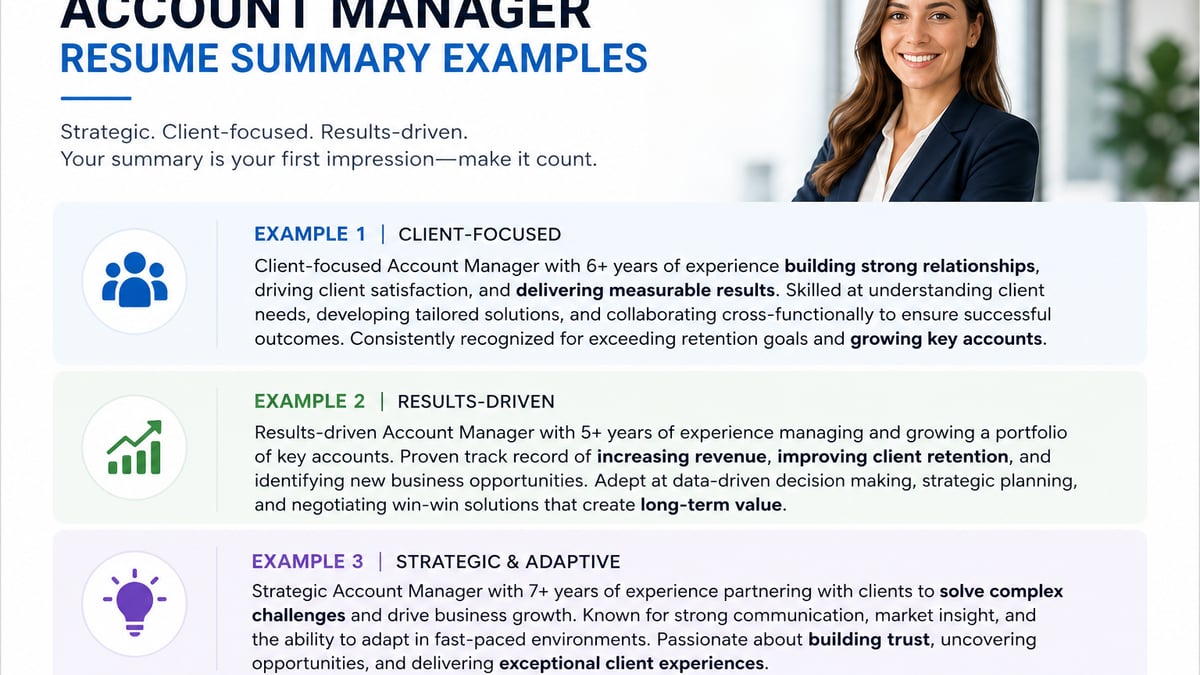
Six account manager resume summary examples by career stage
Archetype C is carried by teardown pairs. Each block below is a different stage. Paste your scope, tools, and honest metrics into the after line. Adapt, don't copy verbatim.
Entry-level account coordinator
Before: Motivated team player seeking an account management role to grow professionally.
After: Account coordinator with 18 months supporting a 200-account SaaS renewal book. Handles inbound client calls, CRM data hygiene, and renewal reminders in HubSpot. Looking to grow into full account ownership.
Mid-level B2B technology
Before: Experienced Account Manager with good communication skills looking to contribute to team success.
After: Account Manager with 4 years in B2B technology, managing client portfolios of 15 to 20 mid-market accounts. Uses consultative check-ins and Salesforce pipeline tracking to identify upsell opportunities and reduce renewal risk.
Mid-level retail or distribution
Before: Results-driven professional skilled in client management, sales, negotiation, CRM, teamwork, and communication.
After: Retail Account Manager with 5 years managing regional distributor relationships. Runs quarterly business reviews, coordinates with merchandising on shelf placement, and tracks account health in a shared CRM to catch churn risk early.
Senior enterprise SaaS
Before: Senior client relationship manager experienced with complex accounts and executive stakeholders.
After: Senior Account Manager with 8+ years owning enterprise SaaS renewals across a portfolio of Fortune 1000 clients. Leads cross-functional renewal strategy with Customer Success and Product, and manages contract negotiations end to end in Salesforce.
Career changer into account management
Before: Customer-focused professional transitioning into account management and client growth roles.
After: Former operations coordinator moving into account management, bringing 3 years of client-facing scheduling and vendor communication. Comfortable owning a book of accounts and learning a new CRM quickly.
Agency or professional services
Before: Dynamic account manager with a proven ability to manage multiple clients and deliver excellent service.
After: Agency Account Manager with 6 years managing 10 to 12 client relationships at a time across creative and paid media campaigns. Coordinates internal teams to hit deadlines and keeps client-facing reporting current in the shared project tracker.
Copy-paste summary skeleton
Copy-paste this skeleton, then fill with your account type and honest scope: "[Title] with [years] in [industry/specialty], managing [book size or account type]. [One renewal, retention, or growth outcome you can defend]. [CRM or platform] for [working style: QBRs, pipeline tracking, or contract management]."
Copy-paste block
Account Manager with [X] years in [SaaS / retail / agency / enterprise],
managing [book size] [account type].
[One outcome: renewal rate, upsell, churn reduction, or QBR cadence].
[Salesforce / HubSpot / Zendesk / Gainsight] for [pipeline / renewals / reporting].
Example fill: "Account Manager with 5 years in healthcare SaaS, managing 22 mid-market hospital accounts. Held gross retention at 94% in 2025 through quarterly business reviews and early churn-risk flags. Salesforce for renewal forecasting and contract amendment tracking."
Edge case: hybrid account manager and sales quota
Some postings blend renewal ownership with upsell quota. Lead with the motion the ad weights heaviest. If the posting repeats expansion ARR in paragraph one, put expansion language in sentence two. If it repeats retention, lead with renewal rate or book stability. Don't stack three different metrics when one honest scope number will do.
For how parsers treat the summary versus Experience bullets, read resume sections ATS reads first before you hide must-have tools only in a Skills footer.
Where weak account manager summaries fail
The teardown pairs repeat the same pattern. Weak files look polished on paper and still die on the first skim.
Adjective stacking. Dynamic, results-driven, detail-oriented tells a recruiter nothing they can search for or verify. Parsers sometimes match soft-skill keywords. Hiring managers never see proof you held a book.
CRM name-dropping without account proof. Salesforce or HubSpot in the summary while Experience bullets say supported clients. Tools belong next to outcomes, not instead of them.
Same summary for SaaS and retail postings. A SaaS onboarding summary reads oddly against a retail buyer-relationship ad. Swap the industry word and the renewal motion before you upload.
Inventing a metric. A made-up retention percentage collapses the moment an interviewer asks you to walk through it. Use a defensible scope instead: 20-plus accounts, quarterly target met, or 200-account support book.
Repeating bullet one verbatim. The summary should tee up the screen, not paste your top bullet. If both lines open with the same portfolio size, you're wasting four sentences of space.
Writing five sentences. If you can't fit your pitch in three or four lines, you likely haven't decided what your strongest proof point is yet. Cut to specialty, scope, tool, and one outcome.
This won't fix applying to enterprise renewals when your book was SMB support. It does stop qualified account managers from losing to a trait-heavy summary while the portfolio scope sat in bullet four.
Parse-test your summary before the next upload
After you rewrite pairs, run the same PDF against the account manager req on your screen. You're checking whether account type, book size, and CRM language appear in the summary block, not only in Skills or a footer of certifications.
When CRM names still miss, add them beside the renewal outcome in the summary, not as a standalone tool list. When industry language still misses, swap sentence one to match the posting's vertical before you tailor keywords in Experience.
Run a free ATS check with the description pasted, then score your job match after you align the summary with the ad's account motion.
Do this now: Paste imported text from the portal preview. If your summary parses below your name, fix section labels before you add another industry keyword.
Rewrite the summary tonight, not the Skills footer
Strong account manager resume summary examples put account type, book scope, and one renewal or growth proof in the first two sentences. CRM names are echoes. Portfolio scope is the screen.
Open the posting. Rewrite four sentences with your honest scope number in line one. Move duplicate portfolio lines out of bullet one if they match word for word. Export a single-column PDF and run a free ATS check before you upload again. When the portal wants a letter, generate a cover letter that repeats the same account scope from your summary.
Job searching is already draining when the file looks fine on your screen. A specific summary saves another week of synonym edits that never touched the real positioning problem.
And if you're targeting both coordinator and full account manager reqs this week, fork the file. Support scope and CRM hygiene lead for coordinator ads. Renewal ownership and QBR language lead for mid-market ads. Same career, different sentence one.
Read more
Frequently asked questions
Keep it to three or four sentences, roughly 50 to 80 words. That is long enough to name your specialty, one proof point, and one or two core skills, and short enough that a recruiter reads the whole thing during a first skim rather than jumping straight to your job titles.
Your years of experience and specialty (SaaS, retail, agency, enterprise), one measurable result such as retention, upsell, or portfolio size, the systems you work in (Salesforce, HubSpot, or similar), and a phrase that signals how you work with clients, whether consultative, cross-functional, or relationship-led.
Use a defensible range instead of a precise number you cannot back up in an interview. Managed a book of 20-plus accounts or consistently met or exceeded quarterly targets are honest and still concrete. Never invent a dollar figure or percentage you cannot explain if asked to walk through it.
You do not need a full rewrite each time, but swap in the industry word and the one or two skills the posting emphasizes most. A summary written for SaaS onboarding reads oddly against a retail buyer-relationship posting, even if the underlying skill set overlaps.