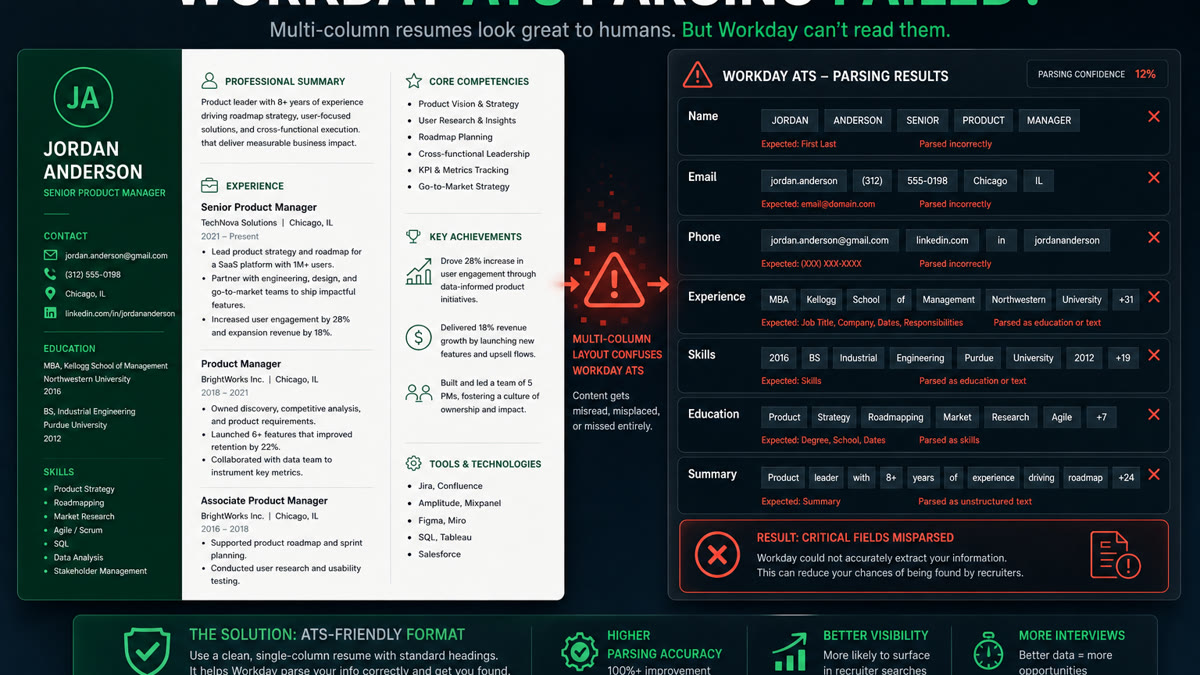
If your resume isn't passing ATS, it's almost always one of five things: missing keywords, layout the parser can't read, a resume that isn't tailored to the role, non-standard section headings, or keyword stuffing that backfires. An ATS (applicant tracking system) is software that parses your resume into structured fields — name, dates, titles, skills — so a recruiter can search and filter candidates later.
This guide walks through each of the five reasons with a concrete fix, plus how to check which one actually applies to your resume in under a minute.
- Key Takeaways
- Missing keywords and bad formatting cause the vast majority of ATS rejections — not lack of qualifications.
- Multi-column layouts, tables, and text boxes are the formatting issues most likely to scramble your data.
- Generic, un-tailored resumes consistently score lower than resumes matched to the specific job description.
- Keyword stuffing can hurt as much as missing keywords — context and natural placement matter.
- A free ATS check takes under a minute and tells you which of these five issues actually applies to you.
Reason 1: Missing or mismatched keywords
Key Takeaway
ATS software ranks resumes partly by how closely your language overlaps with the job description's language — exact terms matter more than synonyms.
Most ATS platforms score or rank candidates based on how well resume text matches terms in the job posting — specific tools, certifications, job titles, and skills. If a posting asks for "project management" and your resume only says "coordinated projects," some parsers won't credit the match, even though a human would understand they're related.
Before: "Helped manage customer accounts and resolved issues."
After: "Managed a portfolio of 40+ customer accounts, resolving escalations and improving retention through proactive account management."
Fix: Pull the exact skill and tool names from the job description and work them into your summary and experience bullets naturally, in context — not as a standalone list at the bottom of the page.
Reason 2: Formatting the parser can't read
Key Takeaway
Visual polish has nothing to do with parseability — a plain single-column resume almost always parses better than a designed template.
Multi-column layouts, tables used for job history, text boxes, and icon graphics are the most common culprits. Workday, in particular, has historically struggled with two-column resumes, sometimes reading straight across both columns instead of down each one, which scrambles job titles and dates. Taleo, an older but still widely used enterprise ATS, tends to be strict about non-standard fonts and can drop text placed inside headers or footers entirely.
Fix: Use a single-column layout, put your contact information in the main body (not a header), and avoid tables, text boxes, and icon-based skill graphics. Standard section headings — "Experience," "Skills," "Education" — parse far more reliably than creative alternatives.
Reason 3: A generic, un-tailored resume
Key Takeaway
The same resume sent to ten different jobs will score differently on each one — matching is relative to the specific posting, not absolute.
Greenhouse and Lever both support recruiters filtering and searching by keyword against a specific requisition, which means a resume optimized for one job title often scores lower against a different one, even in the same field. Sending an identical resume to a "Senior Analyst" role and an "Analytics Manager" role will rarely perform equally well on both.
Fix: Re-order your bullet points so the most relevant experience for each specific posting appears first, and adjust your summary line to reflect the exact job title and top 2-3 requirements listed in that posting.
Not sure which of these five is hurting you?
Run your resume through HireFlow's free ATS checker — upload your PDF or DOCX and get a score with specific, itemized fixes in under a minute, no signup required.
Reason 4: Non-standard section headings
Key Takeaway
Creative section names can confuse field-mapping logic, even when a human reader would understand them instantly.
Headings like "Where I've Made an Impact" instead of "Experience," or "My Toolbox" instead of "Skills," can prevent an ATS from correctly mapping that section's content into the right field. SuccessFactors and iCIMS, both common in mid-size and enterprise hiring, rely heavily on recognizing standard section labels to structure the parsed record.
Fix: Stick to conventional headings — Summary, Experience, Skills, Education, Certifications. Save the creative writing for your bullet points, not your section titles.
Reason 5: Keyword stuffing (the opposite mistake)
Key Takeaway
Overcorrecting by cramming in every possible keyword can hurt you with the human reader even if it doesn't trip an automated filter.
Before (stuffed): "Skills: project management, project management software, managing projects, project lead, project coordination, project planning."
After (natural): "Led cross-functional project teams of up to 8 people, using Asana and Jira to manage timelines and deliverables across three concurrent product launches."
Fix: Use each important keyword once or twice, tied to a real accomplishment, rather than repeating it as a standalone list. If a recruiter or hiring manager ends up reading the resume — which is the entire point of getting past the ATS in the first place — a stuffed resume reads as spam, not expertise.
How to find out which reason applies to you
Key Takeaway
Guessing which of the five issues applies to your resume wastes time — a real parse check tells you directly.
- Upload your resume as a PDF or DOCX to HireFlow's free ATS checker .
- Paste in the job description to see your keyword match rate against that specific posting.
- Review the formatting flags — these point directly to layout issues like columns or tables.
- Fix the highest-severity issue first, then re-scan to confirm the score improved.
This is the same workflow covered in more depth in how to pass an ATS checker and what keywords does ATS look for .
Frequently asked questions
It's usually one of five things: your resume is missing keywords the job description uses, the layout is too complex for the parser (columns, tables, graphics), the resume isn't tailored to the specific role, it uses non-standard section headings, or the reverse problem — it's stuffed with repeated keywords that read as spam. Run it through a free ATS checker to see which of these actually applies to your file.
Missing or mismatched keywords is the most common issue, followed closely by formatting problems like multi-column layouts and tables. A resume can be well-written and still score poorly if it never uses the specific terms — job titles, skills, tools — that appear in the job posting.
Yes. HireFlow's ATS checker is free with no signup required — upload your resume as a PDF or DOCX and get a score with a breakdown of specific keyword and formatting issues in under a minute.
It hurts more often than it helps. Repeating the same keyword unnaturally throughout a resume can look like spam to both modern ATS relevance scoring and the recruiter who eventually reads it. Use each keyword in context, tied to a real accomplishment, rather than listing it repeatedly.
A text-based PDF (not a scanned image) and a standard .docx file are both generally safe across Workday, Greenhouse, Lever, and Taleo. What actually breaks parsing is layout — columns, text boxes, and tables — not the file format itself.
There's no fixed number. Focus on covering the specific skills, tools, and job title language used in the posting you're applying to, worked naturally into your summary and experience bullets. A resume with 10-15 well-placed, relevant keywords typically outperforms one with 40 keywords crammed into a list.
No, and be skeptical of anything that claims it will. Fixing ATS issues means your resume can be read correctly and matched to a role — it doesn't evaluate your actual experience, the number of other applicants, or a recruiter's subjective judgment. It removes a technical barrier; it doesn't replace a strong candidacy.
Done for you
Turn this advice into an interview-ready resume
Professional writers rebuild your resume for ATS + recruiters — unlimited revisions, interview guarantee.