11 min read
A UK CV that shines on a US portal is a single-column file where the first bullet names a tool from the posting and proves scope in the same line. You don't need a new career story. You need seven line-level swaps most candidates skip because they're still formatting for a human who prints on A4.
Check your resume for free before you rewrite bullets. If Workday merged your employer with your degree, keyword edits won't save the upload. Layout first, then the resume writing tips below.
You've probably been told to "stand out." On US corporate reqs, standing out means the recruiter finds your outcome before they click away. Below you'll see what weak CV lines share, six before/after pairs across different roles, and a copy-paste block you can drop into Word tonight. Job searching's draining enough without fighting your own file format.
These tips assume you're keeping UK dates and honest titles while applying through Greenhouse, Lever, or Workday. US strategy, UK facts. No photo, no duty paragraphs, no skills sidebar the parser reads last.
Quick Wins
- Switch to one column and move contact details out of headers.
- Rewrite your top bullet so a posting keyword lands in the first eight words.
- Re-upload once and confirm job titles parsed into separate fields.
Seven resume writing tips: what recruiters judge first
US recruiters scanning a UK CV are not grading design. They're answering three questions in under ten seconds: can this person do the role, have they done it recently, and can our ATS find the proof later.
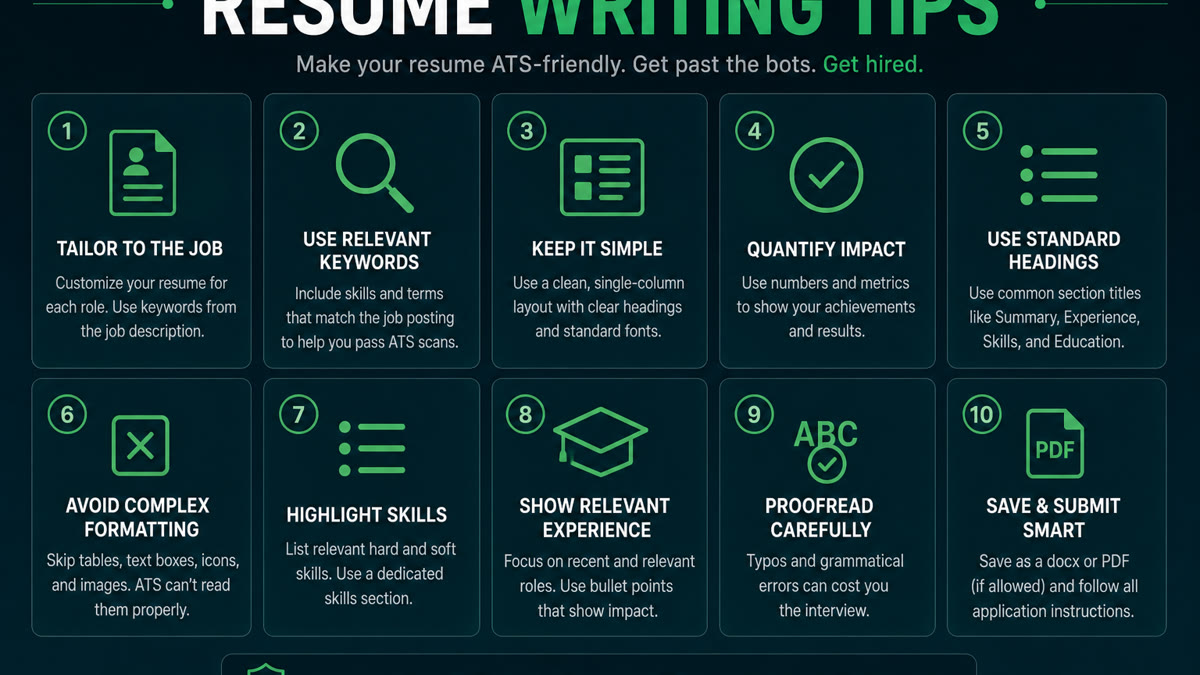
Tip bar one: parser order. Single-column PDF or clean DOCX. Standard headings. Contact block in the body. Month Year dates. No tables, icons, or skill meters. Workday and Taleo still choke on two-column exports from design tools.
Tip bar two: keywords in bullets. The skills line helps search. The bullet that uses the skill in context gets you shortlisted. If SQL only appears in a cloud of tags, the req for "SQL reporting" may never tie to your name.
Tip bar three: numbers in scope. Team size, budget, volume, time saved, error rate. Illustrative figures inside your own work history are fine. Vague "improved processes" is not.
Tip bar four: a profile that names the target role. Two lines max. Role you want plus one proof point from the posting. Not a life story, not "hardworking professional seeking opportunities."
Tip bar five: length that matches stage. One page early career, two when every line supports the application. UK three-page CVs often bury the current role on page two because education and early jobs ate page one.
Tip bar six: verbs that own outcomes. Built, reduced, led, shipped. Not responsible for, involved in, assisted with. Duty language is the fastest signal of a file nobody edited for this req.
Tip bar seven: test before mass apply. One upload to a checker or portal. Confirm fields. Then send ten copies. Silence after thirty generic uploads is harder to fix than one failed parse on night one.
When you're applying from London to a US remote req, you still compete with candidates who already write in US resume shape. The content can stay British. The file structure cannot stay decorative.
This won't fix applying to roles you're not qualified for. It stops a qualified UK CV from dying because Greenhouse read your sidebar before your current title.
Before and after: seven line swaps that actually move
Each pair below maps to one tip. Keep employers and dates. Change the line. Paste from your master CV, not from memory.
Tip 1: keywords in context (marketing coordinator, UK to US SaaS)
Before: Worked with data to help the team make decisions on campaigns and reporting.
After: Built SQL dashboards in Looker for three product teams, tracking weekly paid social ROAS and informing budget shifts on Meta Ads campaigns.
Tip 2: quantify scope (customer support lead)
Before: Managed a team and improved processes for customer queries.
After: Led a team of 5 support reps across Zendesk queues, restructured triage rules, and cut average first response from 6 hours to under 2 on tier-1 tickets.
Tip 3: parser-safe layout (operations analyst)
Before: A two-column Canva CV with contact icons in a left rail, skills stars, and experience in the right column.
After: Single-column 11-point Calibri PDF. Contact line under name, profile, comma-separated skills, then experience with Month Year dates on their own line under each title. Same jobs, readable order in Lever.
Tip 4: profile line that names the role (career switcher into product)
Before: Hardworking professional looking for a new opportunity in tech.
After: Product analyst with 4 years in B2B SaaS ops, focused on roadmap prioritisation, SQL cohort analysis, and stakeholder reporting for US product teams.
Tip 5: trim length without cutting proof (mid-career finance)
Before: Three pages listing every role since university, including part-time retail from 2008.
After: Two pages. Last ten years in detail with four bullets on the current FP&A role. Earlier audit experience condensed to two lines with employer, title, and dates only.
Tip 6: verbs that own outcomes (registered nurse, NHS to US health system)
Before: Responsible for patient care and documentation on a busy ward.
After: Precepted four orientees on a 32-bed med-surg unit, maintained Epic charting at 98% same-day closure, and coordinated discharge planning with case managers on 14-bed average daily census.
Tip 7: test the file before the batch (software engineer)
Before: Sent the same designed PDF to forty Greenhouse links without opening the parsed preview.
After: Exported a plain PDF, uploaded once to a target portal, confirmed "Senior Software Engineer" and employer parsed separately, then tailored summary plus three bullets per posting before sending the rest.
Copy-paste CV skeleton for US portals (rename headers to match your field):
FIRST LAST
City, UK · phone · email · linkedin.com/in/handle

PROFILE
Two lines: target role + strongest proof with a tool or metric from the posting.

SKILLS
Comma-separated: Tool A, Tool B, Method C, Certification D

EXPERIENCE
Company Name | Job Title                    Month Year to Month Year
• Outcome verb + metric + scope in first eight words
• Second bullet with a different skill from the posting
• Third bullet only if it adds new proof

EDUCATION
Degree, Major | School Name                 Year
Paste that into Word or Google Docs. Fill one role completely before you touch the rest. Decorative templates fail when people colour an empty shell instead of fixing bullet one.
Edge case: you need both a full UK CV for local boards and a US-shaped file for remote reqs. Maintain two exports from one master document. Do not send the board CV to Workday.
Edge case: contract roles shorter than six months. One bullet with dates, client sector, and deliverable beats hiding the project. US hiring expects contract lines when the work was real.
Set a timer. Forty-five minutes, one column, one test upload. Tailor words per job tomorrow. Tonight you only want layout and line one solved.
What weak CV versions share on US uploads
Four patterns show up on almost every UK CV that never gets a US callback. Fix these before you chase another listicle.
Mistake 1: skills without bullets underneath. A long skills paragraph with no proof in experience reads like keyword stuffing. Pair each must-have from the posting with one bullet that shows use.
Mistake 2: duty verbs everywhere. Responsible for and involved in tell me you copied a job description. Swap the first verb in your top three bullets tonight.
Mistake 3: design that hides text. Icons, shaded boxes, and column breaks still ship from UK template sites. Parsers read plain text in document order. Pretty PDFs that scramble order look like silence.
Mistake 4: one generic file for thirty reqs. A master CV is smart. Zero tailoring is not. Change profile, reorder bullets, mirror posting language. Ten minutes per application beats one perfect file sent blind.
A composite data analyst still lists Tableau in a sidebar while SQL bullets sit on page two. Greenhouse surfaces skills first. The req asked for warehouse reporting. The parser never ties Tableau to the analyst's name on line one.
Another pattern: UK candidates keep "Curriculum Vitae" as a giant header that eats vertical space. US recruiters expect your name and current title at the top, not a document label from grad school.
Edge case: visa or sponsorship notes. Put work authorization in a cover letter or application field when asked. Don't burn half your profile on immigration text unless the posting requests it upfront.
Edge case: references on page two. "References available upon request" is wasted space. US corporate CVs rarely list referees on the file. Save the lines for another metric.
If your file is two pages, page two should be older roles or optional detail, not a repeat of skills in a new font. Recruiters rarely scroll past bullet three on page one unless line one earned it.
Before you add a seventh tip from another blog, open your export in a plain text editor. If your current job title appears after your hobbies section, your section order is fighting you.
Tools for your next US application batch
You need parsing feedback and a clean starting file, not another theme marketplace.
Run the ATS checker after you strip columns. It flags section order problems before you burn Greenhouse uploads. Fix structure, then tailor keywords per req.
Build your resume from a single-column base if you're starting from scratch. Export DOCX when the portal asks for Word, PDF otherwise. Keep one master file and swap profile plus three bullets per posting.
If the posting asks for a letter, generate a cover letter after the CV file is clean. A designed PDF plus a vague letter is still half a broken application.
Tonight's seven swaps
Open your master CV. Strip columns. Rewrite your top bullet with a posting keyword in the first eight words. Re-upload once. Then send the next application on your list.
These resume writing tips are not a personality makeover. They're line edits that respect how US portals ingest files and how recruiters skim when thirty names land in one afternoon. I've screened stacks of UK CVs in Greenhouse, and boring plus specific beats clever plus scrambled on every high-volume req.
For parser failures that look like silence, read why your resume never reaches a human . Layout fixes come before you rewrite your whole career story.
Pair the CV pass with a quick tailoring method from the ten-minute resume tailoring method for US job posts . Ten minutes per req on a clean file beats an afternoon on a template nobody parsed correctly.
Save the master PDF. Swap profile and top bullets per posting. Decoration is a weekend project. Getting read is tonight's project.
Read more
Frequently asked questions
Keep your UK dates and titles honest, but export a single-column PDF with a short profile, not a two-page narrative CV with icons. US Workday and Greenhouse uploads parse like US resumes. Drop photos, drop column layouts, and put tools from the posting in experience bullets, not only in a skills cloud.
Rewrite your top bullet so the first eight words name a tool or outcome from the posting. That one line changes both keyword search and recruiter skim. You do not need seven new pages. You need one line that sounds like the req.
One page if you are under eight years in the field, two when every line supports the target role. UK candidates often ship three pages of early roles. Trim roles older than ten to fifteen years unless the posting asks for that history. Length is not proof.
Adjust the profile, three bullets, and skills line per posting. One master file is fine. Ten minutes of swaps beats a generic CV sent thirty times. Mirror the posting's exact phrases in context, not in a stuffed paragraph.
Upload the same PDF to a parser checker or your target portal once. Confirm employer names, job titles, and dates landed in separate fields. If sections merged, fix layout before you tune keywords. A clean parse with weak bullets still beats a pretty file the ATS read backwards.