11 min read
You're staring at a blank cover letter field and you're not sure anyone will read past the first line. Fair. A lot of hiring managers skim resumes first and only open the letter when something on the resume needs context. a career change, a referral, a gap, or one result that does not fit in a bullet.
These cover letter tips focus on what gets read: a short opening, one proof paragraph, honest keywords, and a close that does not repeat your resume. Draft faster with the free cover letter generator , then verify facts against a resume you have already run through the free ATS resume checker . For copy-paste patterns, see cover letter examples that get interviews .
Perfect doesn't mean poetic. It means specific, short, and aligned with the posting. the kind of letter you would not be embarrassed to defend if the hiring manager reads it aloud in an interview.
Quick Wins
- Replace Dear Hiring Manager with the recruiter or manager name when the posting or company site lists one.
- Delete every sentence that could apply to any company. add the employer name and one real project.
- Ctrl-F your resume and letter together. titles, dates, and employer names must match exactly.
What a cover letter is for (and when to skip it)
A cover letter is a one-page note that explains why you want this role and gives evidence the resume cannot carry alone. Some applicant tracking systems index letter text for search. Humans use it to judge communication, judgment, and whether you read the posting.
A strong cover letter adds context. referral, career pivot, gap, or one measurable result. it does not restate every bullet on your resume.
Skip optional letters when you would paste the same generic praise to fifty companies. Required field? Write one. Referral? Write one. Changing function or industry? Write one. Optional plus generic is worse than leaving it blank.
I read cover letters when the resume raises a question. Your job is to answer that question in three paragraphs, not to tell me you are passionate about excellence.
Optional cover letter fields are a trap when you are tired. If you would send the same three paragraphs to every employer, leave it blank. Required fields, referrals, career pivots, and gaps are where ten minutes of writing changes whether a recruiter understands your story.
Some ATS products index cover letter text for search. That does not mean keyword stuffing. it means the same honest terms in your resume should appear in your letter inside complete sentences. Mismatched job titles between files are a common red flag I see in screening queues.
Step-by-step cover letter tips
Step 1: Open with the role and one concrete hook
First sentence: exact job title and employer. Second sentence: one reason you fit. a credential, a referral, or a project that mirrors the posting. No throat-clearing about how excited you are to apply.
Weak opening: I am writing to express my interest in your company and believe I would be a great fit.
Strong opening: I am applying for the Financial Analyst role at Northline Health. Jane Ortiz referred me after we partnered on a quarterly variance project she led in 2024.
Step 2: Prove fit with one dated example
Paragraph two is evidence. Pick one project that maps to a must-have in the posting. Name the tool, the scope, and the outcome you can discuss in an interview.
Keep this paragraph under six sentences. If you need more space, your resume bullets are probably carrying the wrong details. fix the resume and let the letter add one angle the bullets cannot, such as a referral name or a career-change bridge.
Composite account executive. weak: I have strong sales skills and work well with clients.
Strong: At my current firm I manage twelve enterprise accounts in Salesforce, renewing $1.2M in ARR last year by leading quarterly business reviews focused on adoption metrics the posting lists as required.
Composite operations hire. weak: I am organized and detail-oriented.
Strong: I coordinated inbound shipments in NetSuite for two distribution centers, maintaining on-time delivery targets during a warehouse management system cutover.
Step 3: Use keywords inside sentences, not lists
Mirror honest terms from the posting. job title, tools, methods. inside your proof paragraph. If the posting says stakeholder communication, show a sentence where you presented to stakeholders, not a bullet list of soft skills.
Some systems search cover letter text. Alignment with your resume matters: if the letter says Senior Analyst and the resume says Analyst, that creates doubt. Match titles and dates exactly unless you explain a deliberate choice in the letter.
Avoid copying the requirements block from the posting into your letter. Recruiters recognize paste jobs. One well-placed term inside a project sentence reads as competence; a paragraph of bolded keywords reads as desperation.
When the posting lists soft skills. communication, leadership, collaboration. show them through action. Presented quarterly results to directors and fielded follow-up questions on budget variance demonstrates communication better than calling yourself an excellent communicator.
Step 4: Address the obvious question briefly
Career change? One sentence on transferable proof. Gap? One honest line on what you did. certification study, caregiving, contract work. without oversharing. Relocation? State availability and timing if the posting asks about location.
Do not apologize. State facts. Hiring managers respect directness more than long explanations.
Step 5: Close without begging
Final paragraph: thank the reader, restate interest in this role specifically, and note availability for interview. Skip I would be honored and delighted to join your world-class team. One sentence is enough.
Sign with your name, phone, and email matching the resume header. Export as PDF with the same naming convention: Firstname_Lastname_Cover_Letter.pdf.
Read the letter aloud once. If you stumble on a sentence or cringe at generic praise, rewrite that line. Hiring managers hear awkward phrasing immediately. especially in the opening where you compete with fifty other letters.
When the portal has separate resume and letter uploads, submit both in one session so facts stay aligned. Uploading a new resume the next day without updating the letter creates mismatches recruiters notice.
Edge case: no hiring manager name available
Use Dear Hiring Manager or Dear [Department] Team when research fails. Spending twenty minutes hunting a name beats a wrong one. Check the posting footer, recent press releases, or the company careers contact. Not random staff directories from outdated pages.
Edge case: very short required field (500 characters)
Treat it as a mini-cover letter: role + one proof line + availability. Cut adjectives. Example: Applying for RN role, Med-Surg. Five years Epic documentation at County Hospital; ACLS current. Available full-time starting March. Same facts must appear on the resume.
Copy-paste cover letter skeleton
Replace the bracketed lines with your facts. Delete any sentence that stays generic after you swap in names.
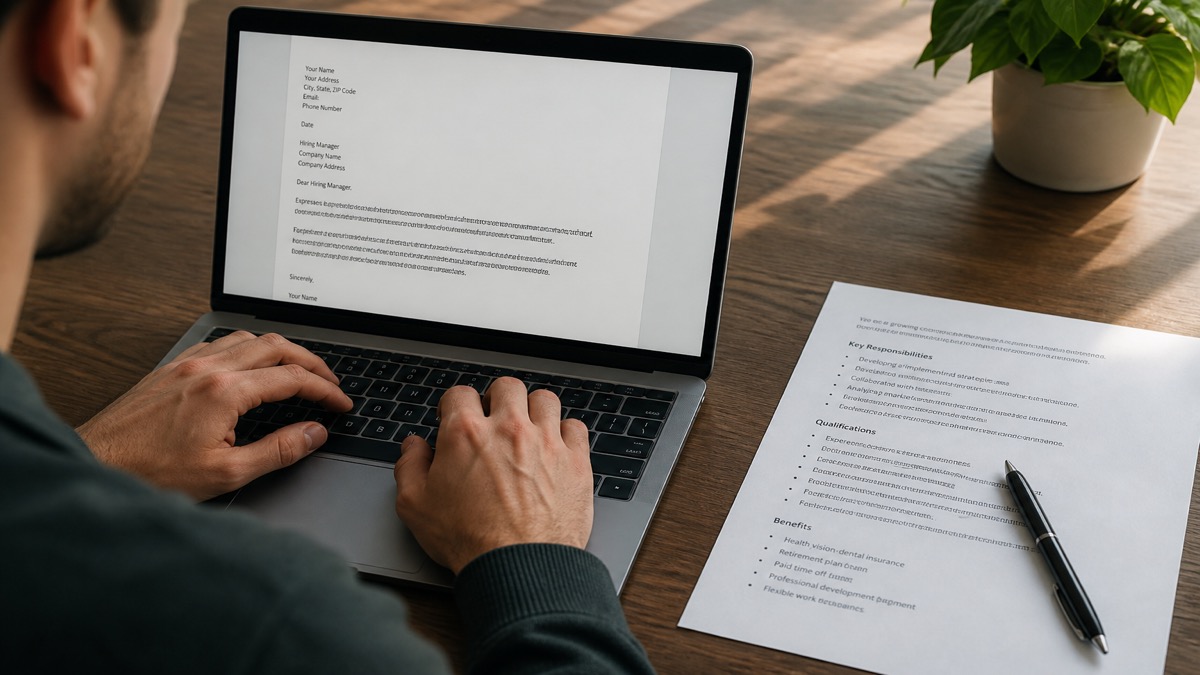
Dear [Hiring Manager name],
I am applying for the [exact job title] role at [Company]. [One sentence: referral, credential, or project that matches a must-have from the posting.]
At [Current or Recent Employer], I [verb] [scope] using [tool from posting], [outcome you can discuss in an interview]. This maps directly to your requirement for [phrase from posting].
[Optional one sentence: career change, gap, or relocation fact. no apology.]
Thank you for your time. I welcome the chance to discuss how my background fits this team.
[Your name]
[Phone] · [Email]
Third composite. teacher to instructional designer: I built LMS modules in Articulate for district-wide onboarding, aligning content to adult learning objectives your posting lists under curriculum design. That sentence belongs in paragraph two, not in a list of soft skills.
For letter plus resume alignment, read how cover letters may be searched for keywords and how to write a cover letter in minutes free .
Cover letter mistakes that get ignored
Repeating the entire resume in paragraph form. I already have the resume. Give me one story the bullets could not carry.
Wrong company or role name. Copy-paste errors end the conversation. Read aloud before you upload.
Generic praise about culture and innovation. Replace it with one sentence about a product, mission, or initiative you researched on the company site.
Two pages of enthusiasm. One page. If you need more space, your resume bullets are probably too vague. fix those too.
Fancy layout on the letter. Plain single-column text parses like a resume. No text boxes or graphics in the upload.
Salary or benefit demands in paragraph one. Save compensation talk for later stages unless the posting explicitly asks for expectations in the letter.
Attaching a letter that contradicts the resume. Different employment dates or job titles between files end trust before the first interview question.
Draft and verify before you upload
Start from the free cover letter generator if a blank page slows you down. Then replace every generic line with employer-specific proof. Run the resume through HireFlow's free ATS resume checker so the letter and CV tell the same story about titles, tools, and dates.
Upload both files in the order the portal requests. If only one text field exists, paste the letter and ensure the resume attachment still matches what you described.
Before you upload, run the resume through the free checker one last time if you edited either file in the last hour. Cover letter edits often prompt resume tweaks. a new bullet to match a claim in paragraph two should trigger a quick alignment check so both documents stay consistent.
Keep a folder per target role: resume PDF, cover letter PDF, posting text, checker notes. When you get a callback months later, you open the exact package you sent instead of guessing which version they have. Crafting the perfect cover letter is easier when your files stay organized from day one.
Send a letter worth ten seconds
Crafting the perfect cover letter is mostly subtraction: one role, one proof paragraph, honest keywords, and facts that match your resume. That is what gets read when a hiring manager has thirty applications left at 6 p.m.
Set a twenty-minute timer when you start a letter. If you cannot name the employer, the role, and one project in the first five minutes, you are not ready to write. go back to the posting and highlight must-haves before you open a blank document. Cover letter tips only work when you have real facts to insert.
- Open with the exact title and one concrete reason you fit.
- Prove fit with a dated project. tool, scope, outcome.
- Match the resume and run a free check before upload.
Open the posting, draft with the cover letter generator , swap in one real project, and pair it with a resume you have already verified. These cover letter tips work because they respect how little time readers actually have. And because every sentence carries a fact you can defend in the room.
Read more
Frequently asked questions
Some do. especially for required fields, referrals, career changes, and senior roles. Write when you add proof, not when you would paste the same letter everywhere.
One page, about 250 to 400 words for most corporate roles. Follow posting limits exactly when they exist.
Use the exact job title once and honest tools or methods from the posting inside your evidence. Do not paste the requirements list.
Use AI as a draft, then replace generic sentences with real employer names, projects, and outcomes you can defend in an interview.
Skip optional uploads when the letter would be identical for every company. Write when required, referred, pivoting careers, or explaining one result that does not fit the resume.